From Atomism to Assembly:
Regenerative Architecture Framework for Building Change
Paper prepared for the 14th annual All-Ireland Architecture Research Group (AIARG) conference on ethical challenges in architecture
Abstract
This paper presents a comprehensive framework for a paradigm shift in architectural thinking that responds to the Grafton Architects' call to consider "Earth as our client." Moving from reductionist atomism to an interconnected, assembly-based perspective, we explore architecture's ethical responsibilities beyond conventional professional codes of conduct. By synthesizing insights from assembly theory, constructor theory, EMERGY analysis, and complexity science, we propose a framework that reframes architecture as an agent of regeneration rather than consumption. This approach integrates lineage assembly, counterfactual thinking, and multi-scale systems analysis to address contemporary ethical challenges including climate change and housing crises. The paper argues that architects have fundamental duties to the environment, heritage, public space, society, and the profession itself that require transcending traditional disciplinary boundaries and Newtonian physics-based approaches to embrace complexity, emergence, and deep time awareness. Central to this framework is the recognition that architectural practice must move beyond solitary creation toward co-creation through Communities of Practice (CoP) and transdisciplinary collaboration. These communities, operating at various scales of assembly, harness collective intelligence to develop robust performance strategies aligned with Sustainable Development Goals. Through this framework, we offer a pathway for architects to fulfill their expanded ethical obligations to create built environments that contribute to ecological and social regeneration through knowledge-based problem-solving and systems thinking.
1. Introduction
Beyond Reductionism and Toward Ethical Practice
The contemporary challenges facing our built environment—climate change, resource depletion, housing crises, and social inequity—cannot be adequately addressed through conventional architectural approaches rooted in reductionist thinking or narrow conceptions of professional ethics. As articulated in the Grafton Architects' Freespace manifesto for the Venice Biennale 2018, architects must embrace "Earth as our client," recognizing ethical responsibilities that extend far beyond traditional professional obligations to immediate human stakeholders (Farrell & McNamara, 2018).
This expanded understanding of architectural ethics demands a fundamental paradigm shift in how we conceptualize, design, and construct our built world (Moe, 2019). This paper proposes an "Assembly-Based Framework" that moves beyond atomistic perspectives toward a more integrated, complex understanding of architecture as a knowledge-creating enterprise with profound ethical implications for the environment, heritage, public space, society, and the profession itself.
The term "Assembly-Based" acknowledges the historical trajectory from the atomism of Democritus and Leucippus through to contemporary understandings of complexity and emergence. Unlike atomic theory, which focuses on irreducible components, assembly theory focuses on the historical processes and pathways through which complex entities come into being (Walker, 2022). This perspective is particularly relevant to architecture, which inherently involves the assembly of materials, systems, and ideas into functional wholes with long-lasting ethical consequences.
This paper draws on diverse intellectual traditions, from physics and complexity science to information theory and biology, to articulate a comprehensive framework for Regenerative Architecture and Building Change (BC) that addresses the expanded ethical responsibilities of architects in the 21st century. We begin by examining the limitations of reductionist approaches and tracing the evolution of scientific thinking from atomism to assembly theory. We then explore key principles of the Assembly-Based Framework, including lineage assembly, constructor theory, and EMERGY analysis. Throughout, we focus on how this framework enables architects to fulfill their ethical duties to the environment, heritage, public space, society, and the profession itself.
2. Earth as Our Client
Expanding Architectural Ethics
2.1 Beyond Professional Codes of Conduct
Traditional architectural ethics, as codified in professional standards like the RIAI Code of Professional Conduct or the RIBA Code of Professional Conduct, primarily focus on architects' responsibilities to clients, colleagues, and the public in terms of honesty, competence, and fairness. While these codes sometimes reference sustainability and the environment, they often treat these as secondary considerations rather than central ethical imperatives (Samuel, 2018).
The Grafton Architects' "Earth as our client" manifesto fundamentally challenges this limited ethical framework. As Shelley McNamara and Yvonne Farrell (2018) articulate:
"We believe that the Earth is Architecture's Client. This brings with it long-lasting responsibilities—environmental, social, and cultural."
This perspective elevates environmental stewardship from a secondary consideration to a primary ethical obligation, positioning Earth—and by extension all its inhabitants and systems—as the ultimate client to whom architects are accountable. This expanded clientele includes:
- Future generations: Recognizing intergenerational equity in resource use and environmental impact
- Non-human species: Acknowledging our ethical obligations to biodiversity and ecosystem health
- Geological systems: Understanding buildings as interventions in Earth's long-term geological processes
- Cultural heritage: Preserving and enhancing the cultural significance of places across time
The Assembly-Based Framework provides a structured approach to fulfilling these expanded ethical obligations, offering both a theoretical foundation and practical methodologies for architecture that truly serves "Earth as client."
2.2 The Atomistic Legacy and Its Ethical Limitations
The concept of atomism—that physical reality can be reduced to indivisible, fundamental particles—originated with the ancient Greek philosophers Democritus and Leucippus in the 5th century BCE, not with Aristotle or Plato as sometimes misattributed (Warren, 2007). This atomistic worldview laid the groundwork for modern scientific reductionism, the belief that complex phenomena can be understood by breaking them down into simpler components.
This reductionist approach has had profound ethical implications for architecture. By focusing on buildings as collections of discrete components rather than integrated systems within larger contexts, it has enabled architects to ignore or externalize the broader impacts of their work:
- Environmental impacts: Treating materials as isolated resources rather than parts of ecological systems
- Social consequences: Focusing on individual buildings rather than their contributions to community wellbeing
- Cultural effects: Separating "new" architecture from existing cultural and historical contexts
- Temporal horizons: Privileging immediate construction over long-term lifecycle considerations
As philosopher of science Isabelle Stengers (2018) argues, this atomistic thinking produced a "disenchanted world" where ethical considerations were increasingly separated from scientific and technical knowledge. The Assembly-Based Framework seeks to "re-enchant" architectural practice by reuniting technical knowledge with ethical responsibilities through a focus on relations, processes, and emergent properties.
3. Key Principles of the Assembly-Based Framework
3.1 Scale, Perception, and Knowledge: Schrödinger's Insight
In his groundbreaking work "What is Life?", Erwin Schrödinger presents a profound insight about scale that is fundamental to our framework. He asks why atoms are so small, then reframes this as the real question: "Why must our bodies be so large compared with the atom?" This question reveals the crucial relationship between scale and knowledge creation that underpins the Assembly-Based Framework.
Schrödinger notes how human measurement systems naturally relate to bodily dimensions—"the yard was supposedly defined by an English king who said, 'Take the distance from the middle of my chest to my fingertips.'" In contrast, atoms exist at scales measured in Ångströms (10^-10 meters). This vast disparity isn't coincidental but necessary for our existence as thinking beings.
As Schrödinger explains, if organisms were so sensitive that "a single atom, or even a few atoms, could make a perceptible impression on our senses," orderly thought would be impossible. Our ability to perceive, think, and create knowledge depends on existing at a scale where statistical laws emerge from atomic chaos—where patterns become stable and predictable enough to form the basis of perception and thought.
This insight connects directly to Buckminster Fuller's work in Synergetics, where he explored the "geometry of thinking"—how our cognitive processes are fundamentally shaped by our perception of spatial relationships at particular scales. For architects, this means recognizing that buildings must function across multiple scales simultaneously:
- The atomic scale: Where material properties emerge from molecular structures
- The human scale: Where perception and experience occur
- The ecological scale: Where buildings interact with broader natural systems
- The planetary scale: Where collective architectural decisions impact Earth systems
The Assembly-Based Framework embraces this multi-scale reality, designing with awareness of how architectural decisions at one scale propagate to others, fulfilling ethical responsibilities across all scales.
3.2 Brownian Motion: The Link Between Scale and Order
Brownian motion—the random movement of particles suspended in a fluid—provides a crucial link between scale and order that is central to our framework. First observed by Robert Brown in 1827 and later explained by Albert Einstein in 1905, Brownian motion was experimentally confirmed by Jean-Baptiste Perrin, who received the Nobel Prize in Physics in 1926 for this work.
Schrödinger identifies Brownian motion as the "completely disorderly heat motion" performed by all atoms, which has profound implications for how we understand order and complexity:
- At small scales involving few atoms, random thermal motion "opposes itself to their orderly behavior" making recognizable patterns impossible
- Only with "enormously large number of atoms do statistical laws begin to operate and control the behavior of these assemblies with an accuracy increasing as the number of atoms involved increases"
This explains why organisms capable of orderly thought must be composed of enormous numbers of atoms. The physical laws that enable life and consciousness are statistical in nature, emerging only when vast numbers of atoms work together, overcoming the chaotic effects of Brownian motion.
For architects, this insight reveals why buildings must achieve specific levels of complexity to resist entropy and maintain functional organization. Buildings with insufficient complexity (too simple, monolithic, or rigid) lack the adaptive capacity to respond to changing conditions and inevitably fail over time. Conversely, buildings with multi-scale complexity—integrating diverse systems, materials, and functions—can achieve greater resilience and adaptability.
This understanding informs a more ethical approach to architectural design that embraces complexity not as an aesthetic choice but as an ecological and functional necessity. By designing buildings with appropriate complexity at multiple scales, architects can create structures that better serve both human and non-human inhabitants while remaining adaptable to changing conditions over time.
3.3 Assembly Index: A New Metric for Material Accountability
Sara Walker and Lee Cronin's concept of assembly index provides a revolutionary framework for understanding complexity that transforms how we account for materials in architecture. Unlike traditional approaches that focus on mass, energy content, or carbon footprint, assembly index measures "the minimal history of physically possible, recursive operations that must occur for an object to appear in the universe" (Walker, 2022).
This approach captures the information content and selection history embedded in a material's structure, quantifying how much selection has occurred to create a particular configuration. Walker's research reveals a critical threshold at fifteen assembly steps—molecules requiring fifteen or more assembly steps appear to be exclusively produced by living systems on Earth, providing an objective boundary between abiotic and biotic processes.
For architectural ethics, assembly index offers several advantages:
- Historical awareness: It recognizes that materials exist not just in space but in time, with their assembly pathways forming an essential part of their nature
- Information visibility: It makes visible the hidden information content in materials, not just their physical properties
- Selection accountability: It quantifies the degree of selection required to create materials, revealing their true environmental costs
- Biotic boundary recognition: It distinguishes between materials that can be produced through purely physical processes versus those requiring biological intervention
In practice, architects can use assembly index to:
- Select materials with appropriate assembly complexity for their intended function and lifespan
- Design with awareness of assembly pathways, not just end products
- Prioritize materials that can be disassembled and reassembled in new configurations
- Value traditional building techniques that embody high assembly indices without high energy costs
The concept of assembly index aligns with circular economy principles but adds a crucial informational dimension, recognizing that the value of materials lies not just in their physical properties but in the information and selection processes embedded within them.
3.4 EMERGY Analysis and "Starting with the Sun"
EMERGY (spelled with an "m") methodology, developed by Howard T. Odum, offers a complementary approach to assembly index by measuring the total energy used in making a product, considering both direct and indirect energy inputs, including "the work of nature" in generating raw resources.
The concept of "Starting with the Sun" is fundamental to EMERGY analysis, recognizing that virtually all energy on Earth ultimately derives from solar energy. As Schrödinger noted in "What is Life?": "Plants have their most powerful supply of 'negative entropy' in the sunlight."
EMERGY analysis traces energy flows from their ultimate source (mostly the Sun) through all transformations until they become part of the product being analyzed. This includes the energy embedded in ecological processes, geological formations, and evolutionary history.
For architectural ethics, EMERGY analysis offers:
- Comprehensive accounting: Revealing the full environmental costs of materials and processes
- System boundary expansion: Including natural processes that traditional accounting ignores
- Quality differentiation: Recognizing that different forms of energy have different qualities and values
- Deep time awareness: Acknowledging geological and ecological timeframes
By combining assembly index and EMERGY analysis, the Assembly-Based Framework provides a more complete picture of materials and buildings as both information-bearing structures and embodiments of energy flows. This integrated approach helps architects fulfill their ethical obligations to the environment by making visible the full consequences of their material choices.
3.5 Constructor Theory and Ethical Possibility
Chiara Marletto's constructor theory provides a powerful framework for understanding systems in terms of what transformations are possible and impossible rather than focusing solely on what happens according to deterministic laws. This counterfactual approach shifts focus from buildings as static objects to buildings as dynamic systems capable of multiple potential transformations.
As Marletto (2021) explains, constructor theory asks "what tasks are possible, what transformations could happen, and why." This approach is particularly valuable for architectural ethics because it enables architects to design not just for immediate functions but for future adaptability and transformation.
The "farmer game" analogy that Marletto uses illustrates this approach: a farmer doesn't just plant seeds and hope for the best but creates the conditions that make successful growth possible, intervening when necessary to ensure desired outcomes. Similarly, architects should design buildings not as fixed objects but as systems that enable certain transformations while preventing others.
Constructor theory has profound implications for how architects understand their ethical duties:
- Heritage as possibility space: Understanding heritage not as static preservation but as creating conditions for cultural evolution
- Public space as constructor: Designing public spaces that enable diverse social interactions and transformations
- Adaptive reuse as ethical imperative: Recognizing the ethical value of transforming existing structures rather than demolishing them
- Resilience as counterfactual capacity: Designing for resilience by ensuring buildings can adapt to multiple possible futures
By focusing on what transformations are possible rather than just what currently exists, constructor theory helps architects fulfill their ethical obligations to future generations by creating buildings and spaces that can adapt to changing needs and conditions.
3.6 Lineage Assembly and Multi-Species Justice
Assembly theory provides a framework for understanding how complexity and novelty arise through historical processes. This perspective sees buildings not as isolated objects but as part of ongoing lineages that include social, cultural, and multi-species interactions in emergent environments.
"We are accustomed to thinking about technology as uniquely human, but in the broader definition I propose, there are many examples across biology too... Unifying matter and computation, as we do in assembly theory to explain life, also has the implication that we should unify biology and technology as manifestations of the same fundamental process: selection on what gets to exist." (Walker, 2022, p. 76)
This unification of biology and technology suggests that buildings can be understood as part of the same fundamental process that shapes biological systems—selection on what gets to exist. Buildings become not just human artifacts but participants in larger evolutionary processes involving multiple species and systems.
This perspective demands what philosophers like Sue Donaldson and Will Kymlicka (2011) call "multi-species justice"—an ethical framework that recognizes and respects the interests of non-human beings. For architects, this means:
- Designing for biodiversity: Creating buildings that support rather than displace non-human life
- Recognizing multi-species communities: Understanding buildings as habitats for diverse organisms
- Considering evolutionary impacts: Acknowledging how architectural decisions affect biological evolution
- Supporting ecosystem services: Designing to enhance rather than disrupt natural processes
The Assembly-Based Framework thus offers a path toward fulfilling architects' ethical obligations to the environment by recognizing buildings as participants in multi-species assemblages with responsibilities extending far beyond human users.
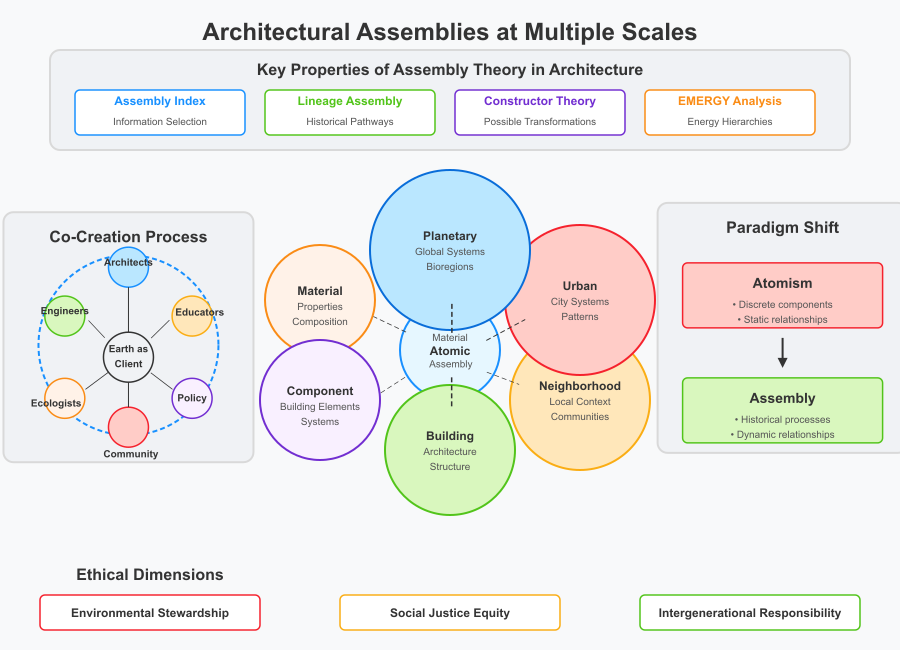
Figure 1: Architectural Assemblies at Multiple Scales. This diagram illustrates the non-linear relationships between architectural assemblies from the atomic scale to the planetary scale. The key properties of Assembly Theory—Assembly Index, Lineage Assembly, Constructor Theory, and EMERGY Analysis—provide the theoretical foundation for understanding these relationships. The diagram also shows the paradigm shift from Atomism to Assembly and the centrality of co-creation with 'Earth as Client' at the core of the Communities of Practice.
4. Comprehensive Architectural Analysis
An Ethical Imperative
4.1 The Comprehensive Architectural Loads Framework
The Assembly-Based Framework requires a comprehensive approach to architectural analysis that integrates multiple scales and domains. The Comprehensive Architectural Loads diagram (Figure 1) provides a structured approach to this integration, mapping how material, energy, occupancy, and urban context interact across scales.
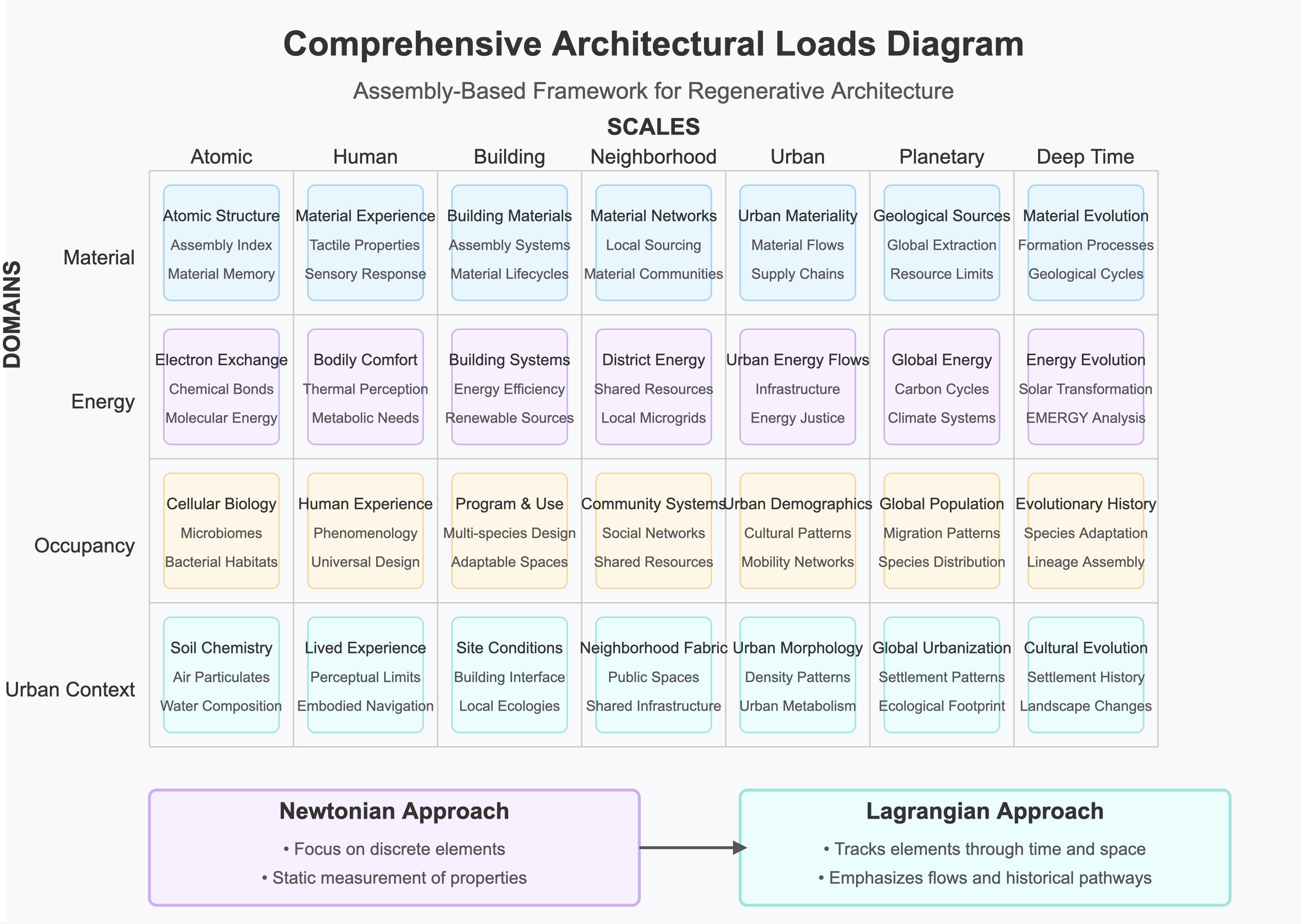
Figure 2: Comprehensive Architectural Loads Diagram. This matrix maps the interactions between material flows, energy hierarchies, occupancy patterns, and urban contexts across temporal and spatial dimensions. The diagram visualizes how Newtonian approaches (focusing on discrete elements) differ from Lagrangian approaches (tracking elements through time and space) in architectural analysis. The archipelago represents the distributed yet connected Communities of Practice essential for implementing the Assembly-Based Framework.
This framework contrasts the Newtonian and Lagrangian approaches to architectural analysis, with profound ethical implications:
| Aspect | Newtonian Approach | Lagrangian Approach | Ethical Implications |
|---|---|---|---|
| Material | Concrete wall, 20cm thick | Tracks limestone extraction, cement production, mixing, pouring, curing, weathering, and eventual demolition/recycling | Reveals the full environmental and social impacts of material choices |
| Energy | Annual heating demand: 50 kWh/m² | Follows solar energy from sun to PV panel to battery to electrical devices, including embodied energy of all components | Makes visible the energy hierarchies and true costs of building operation |
| Occupancy | Office space for 50 people | Analyzes flow of people through the space over the building's lifetime, including changing work patterns | Acknowledges the social and cultural dimensions of architectural space |
| Urban context | Building footprint and height | Examines how the building influences and is influenced by urban energy flows, microclimates, and social patterns over decades | Recognizes buildings as participants in larger urban and ecological systems |
The Lagrangian approach aligns with assembly theory by tracking elements through time and space, recognizing the historical pathways through which buildings and their components come into being and transform over time. This comprehensive analysis is not just technically superior but ethically necessary, as it enables architects to fully understand the consequences of their decisions.
4.2 The Problem of Infinite Decimals vs. Order of Magnitude Thinking
David Deutsch's distinction between "decimal" and "order of magnitude" thinking is crucial for architectural ethics. Decimal thinking involves incremental improvements within existing paradigms—making buildings slightly more energy-efficient or using marginally better materials. Order of magnitude thinking involves fundamental paradigm shifts that create entirely new possibilities—reimagining what buildings are and how they function within larger systems.
As Deutsch argues in "The Beginning of Infinity" (2011), problems are soluble, but solving them requires creating new knowledge rather than just optimizing existing approaches. Addressing contemporary challenges like climate change and the housing crisis requires order of magnitude thinking—fundamental paradigm shifts rather than incremental improvements.
The Assembly-Based Framework represents order of magnitude thinking by fundamentally reframing architecture as a process of lineage assembly rather than static construction. This shift enables architects to address contemporary challenges at their root causes rather than just ameliorating their symptoms.
As Deutsch notes, "It is inevitable that we face problems, but no particular problem is inevitable. We survive, and thrive, by solving each problem as it comes up." This optimistic stance aligns with the Assembly-Based Framework's view that while architectural challenges are inevitable, they are also soluble through the creation of new knowledge and approaches.
4.3 Integrating Technical and Ecological Systems
The concept of "Ecological Shearing Layers" extends Stewart Brand's shearing layers model to include ecological systems. This integration recognizes that buildings exist within nested ecological contexts, from microbiomes within buildings to regional ecosystems.
From an ethical perspective, this integration acknowledges architecture's profound impact on ecological systems and the ethical imperative to design with these systems in mind. As ecologist David Tilman (2000) argues, "The simplification of natural ecosystems for human use has led to dramatic losses in biodiversity." Architects have an ethical obligation to reverse this trend by creating buildings that support rather than diminish biodiversity.
The integration of unbuilding principles—deconstruction, adaptability, circularity—with ecological thinking creates a framework for truly regenerative architecture.
The integration of unbuilding principles—deconstruction, adaptability, circularity—with ecological thinking creates a framework for truly regenerative architecture. This approach recognizes that buildings are not just technical artifacts but living systems that interact with their environments in complex ways. It fulfills architects' ethical obligations to the environment by:
- Designing for biodiversity: Creating spaces that support diverse species
- Integrating ecological processes: Incorporating natural cycles into building systems
- Minimizing ecological disruption: Designing to preserve and enhance existing ecosystems
- Creating regenerative relationships: Establishing positive interactions between buildings and natural systems
Through this integration of technical and ecological thinking, the Assembly-Based Framework enables architects to fulfill their ethical obligations to all life on Earth.
5. Applications to Contemporary Ethical Challenges
5.1 Climate Action as Ethical Imperative
The Venn diagram on "Finding Joy in Climate Action" provides a useful framework for addressing climate change through architecture:
- Things you are good at: Leveraging architectural expertise and knowledge
- Things the climate crisis needs: Addressing specific challenges like emissions reduction, adaptation, and resilience
- Things that bring you joy: Finding personal fulfillment in climate action
At the intersection of these three circles is where architects can make their most significant contributions to climate action. This approach recognizes that sustainable change requires not just technical solutions but personal engagement and fulfillment.
From an ethical perspective, addressing climate change is not optional for architects but a fundamental obligation. As architect Edward Mazria (2003) argues in the 2030 Challenge, "The building sector is the single largest contributor to global warming and must be a key focus of mitigation efforts." The Assembly-Based Framework enhances climate action by providing a comprehensive methodology for understanding and addressing climate challenges across scales, from material selection to urban planning.
Specific ethical obligations related to climate change include:
- Mitigation: Reducing greenhouse gas emissions through energy-efficient design, renewable energy integration, and low-carbon materials
- Adaptation: Creating buildings resilient to changing climate conditions
- Carbon sequestration: Designing buildings and landscapes that actively remove carbon from the atmosphere
- Just transition: Ensuring that climate solutions do not disproportionately burden vulnerable communities
By focusing on lineage assembly, constructor theory, and EMERGY analysis, architects can develop solutions that address the root causes of climate change rather than just its symptoms, fulfilling their ethical obligation to current and future generations.
5.2 The Housing Crisis as a Justice Issue
The global housing crisis represents not just a technical challenge but a profound ethical issue related to justice, equity, and human rights. The United Nations recognizes adequate housing as a fundamental human right, yet billions of people worldwide lack access to safe, affordable housing. Architects have an ethical obligation to address this crisis through their practice.
The Assembly-Based Framework reframes the housing crisis as a systems problem that requires understanding the historical pathways that have led to current conditions and the potential transformations that could lead to more equitable, sustainable housing systems. This approach emphasizes:
- Understanding housing lineages: Tracing the historical development of housing systems and their social, economic, and ecological contexts
- Identifying counterfactual possibilities: Exploring what housing systems could be possible under different constraints and conditions
- Designing for adaptation and transformation: Creating housing that can evolve and adapt to changing needs and conditions over time
- Integrating multiple scales: Addressing housing at the scales of materials, buildings, neighborhoods, and cities
From an ethical perspective, architects must consider housing not just as shelter but as a fundamental human right and ecological intervention. This requires balancing multiple ethical obligations:
- Right to adequate housing: Ensuring that housing meets basic human needs for shelter, safety, and dignity
- Environmental impact: Minimizing the ecological footprint of housing
- Cultural appropriateness: Respecting cultural traditions and preferences
- Economic accessibility: Creating housing that is affordable for all income levels
- Community integration: Designing housing that supports social connection and community wellbeing
Beyond these obligations, the Assembly-Based Framework extends architecture's client brief to explicitly include marginalized communities, particularly persons with disabilities. Collaborative research with Gerard Quinn, UN Special Rapporteur on the rights of persons with disabilities, demonstrates that truly inclusive built environments transcend mere compliance with accessibility standards—they fundamentally reconceptualize how neighborhoods enable human flourishing across diverse abilities (Quinn, 2002). Quinn's rights-based approach complements assembly theory by revealing how built environments, as complex assemblages, either enable or constrain human capabilities through their configuration and interconnectedness. The walkable, inclusive neighborhood emerges as a critical scale of intervention where architectural decisions directly impact social equity, community resilience, and personal agency. This perspective acknowledges that when we consider "Earth as client," we must address the full spectrum of human diversity within Earth's ecological systems, creating neighborhoods that support physical, social, and cultural accessibility as integral components of environmental justice. By designing for this expanded client brief, architects fulfill their ethical obligations not only to abstract ecological systems but to the diverse human communities who inhabit and give meaning to those systems.
By focusing on assembly rather than just construction, this approach can address not just the quantitative shortage of housing but the qualitative dimensions of the crisis—how to create homes that support human flourishing while regenerating natural systems.
5.3 Heritage as Dynamic Lineage
Traditional approaches to architectural heritage often focus on preservation—maintaining buildings in their "original" state as historical artifacts. The Assembly-Based Framework offers a more dynamic understanding of heritage as ongoing lineage, recognizing that buildings are not static objects but evolving assemblages with multiple potential futures.
This perspective aligns with contemporary heritage theory, which increasingly recognizes what Rodney Harrison (2013) calls the "dialogic" nature of heritage—that heritage is not fixed in the past but continually recreated through interaction between past, present, and future. For architects, this implies specific ethical obligations:
- Respecting historical lineages: Understanding the evolutionary history of buildings and sites
- Enabling future adaptation: Creating conditions for buildings to evolve while maintaining cultural significance
- Incorporating multiple perspectives: Recognizing that heritage has different meanings for different communities
- Supporting cultural continuity: Designing interventions that enhance rather than disrupt cultural narratives
The constructor theory aspect of the Assembly-Based Framework is particularly relevant here, focusing on what transformations are possible and impossible while maintaining cultural significance. This approach enables architects to fulfill their ethical obligations to heritage by creating possibility spaces that enable cultural evolution while respecting historical lineages.
6. Implementation: Fulfilling Architecture's Ethical Potential
6.1 Virtual-Physical Integration and Ethical Experience
The unique qualities of virtual space—teleporting, overlap, synchronous and asynchronous interconnectedness—offer powerful tools for enhancing architectural experiences and functions. However, digital space can also flatten experiences and eliminate the sense of progression, sequence, and embodiment that is crucial for creating meaningful places.
An Assembly-Based approach seeks to integrate physical and digital spaces in ways that leverage the strengths of both while mitigating their weaknesses. This integration must be guided by ethical considerations about how digital environments affect human experience and social interaction.
By understanding both physical and virtual space through the lens of assembly theory, architects can create hybrid environments that:
- Preserve embodied experience: Maintaining the crucial phenomenological aspects of architecture in digital contexts
- Enable new forms of social interaction: Creating spaces for meaningful connection across physical distances
- Reveal hidden systems: Using digital tools to make visible the energy, material, and information flows that sustain buildings
- Enhance adaptability: Enabling buildings to respond to changing needs through digital-physical feedback loops
This integration recognizes that the distinction between physical and digital is increasingly blurred, and that architecture must address both domains as part of a continuous experience landscape while maintaining ethical commitments to embodied experience and social connection.
6.2 Educational Implications for Ethical Practice
Implementing the Assembly-Based Framework requires a transformation in architectural education to prepare future architects for expanded ethical responsibilities. This transformation moves beyond the traditional studio model of individual design excellence toward collective intelligence and transdisciplinary problem-solving. This educational shift involves:
- Transdisciplinary curriculum: Transcending disciplinary silos by integrating knowledge from diverse fields including ecology, physics, materials science, social sciences, indigenous knowledge systems, and community-based practices
- Systems thinking skills: Developing students' abilities to analyze, design, and intervene in complex, interconnected systems across multiple scales
- Deep time awareness: Fostering understanding of geological and evolutionary timescales and their implications for architectural decisions
- Computational modeling and collective intelligence: Using digital tools to simulate complex systems dynamics while developing collaborative frameworks that aggregate diverse forms of knowledge
- Ethical reasoning: Cultivating students' capacity to navigate complex ethical dilemmas while recognizing the inherent value pluralism in architectural problems
- Cultural sensitivity and justice awareness: Building awareness of diverse cultural perspectives and values while addressing systemic inequities in the built environment
- Collaborative practice: Creating educational environments that mirror the Communities of Practice students will engage with professionally, emphasizing co-learning, peer feedback, and collective knowledge creation
- Reflexive practice: Developing habits of critical reflection on one's own assumptions, biases, and worldviews that influence design decisions
The transformation of architectural education must move from the "studio master" model toward learning circles where knowledge flows multi-directionally. The flipped classroom approach exemplified in programs like the "Reviving Buildings" module demonstrates how students and educators can collectively engage with complex problems, sharing expertise and developing solutions that no individual could create alone.
This educational approach aligns with what we might term "Regenerative Design Pedagogy," which emphasizes not just the integration of technical, ecological, social, and ethical knowledge, but the creation of learning environments that themselves function as regenerative systems—creating more value than they consume through knowledge exchange and collaborative innovation. By educating architects in this comprehensive way, we prepare them not just as individual practitioners but as effective participants in the Communities of Practice necessary to fulfill expanded ethical obligations to the Earth and all its inhabitants.
6.3 Communities of Practice and Co-Creation in Architectural Ethics
The Assembly-Based Framework fundamentally challenges the notion of architecture as a solitary creative endeavor. Instead, it positions architectural practice as an inherently collaborative process embedded within Communities of Practice (CoP). These communities—comprised of diverse stakeholders including architects, engineers, ecologists, social scientists, policymakers, and community members—function as living assemblies that generate collective intelligence and shared understanding.
Drawing on Wenger's (1998) concept of Communities of Practice, we understand these collectives as groups that share a concern or passion for something they do and learn how to do it better through regular interaction. For architectural ethics, CoPs provide several essential functions:
- Knowledge aggregation: Pooling diverse expertise to address complex challenges
- Adaptive learning: Evolving practices in response to changing conditions and feedback
- Ethical accountability: Creating shared norms and standards that exceed individual codes of conduct
- Resilience through diversity: Strengthening solutions through multiple perspectives and approaches
Co-creation, as conceptualized by Arnstein's (1969) "Ladder of Citizen Participation," represents a critical methodology within these communities. By moving beyond token consultation to genuine partnership, co-creation transforms the relationship between architects and those affected by their work. This approach recognizes that addressing complex challenges like climate change and housing crises requires the integration of diverse forms of knowledge—technical, experiential, indigenous, and cultural.
The transdisciplinary nature of these assemblies is essential for confronting what sustainability theorist Rittel termed "wicked problems"—challenges characterized by complexity, uncertainty, and value conflicts (Rittel & Webber, 1973). Unlike traditional multidisciplinary approaches where disciplines remain separate, transdisciplinarity integrates insights across boundaries to create new, emergent knowledge frameworks that transcend disciplinary limitations.
In practice, these Communities of Practice manifest in various forms:
- Building Change initiatives that connect educational institutions
- Living laboratories that integrate research, practice, and community engagement
- Cross-sector collaborations between architecture, ecology, and social services
- Digital platforms that enable knowledge sharing across geographical boundaries
These communities, operating at various scales of assembly, collectively develop the robust performance strategies and architectural vocabularies necessary for achieving Sustainable Development Goals and creating healthy habitats for all species.
6.3.1 Pedagogical Application: The Building Change Initiative
The Building Change (BC) initiative serves as a concrete example of the Assembly-Based Framework in educational practice. This initiative connects six architectural schools across Ireland, creating an archipelago of learning communities that collectively address climate resilience in architectural education.
Within this initiative, the "Reviving Buildings" module exemplifies the principles of co-creation and transdisciplinary collaboration. This five-credit master's level course transforms traditional educational hierarchies by implementing a flipped classroom approach where participants—including conservation architects, climate change officers from local government, and graduate students—function simultaneously as both learners and teachers. The module operates as a learning circle where knowledge flows multi-directionally rather than from a single authoritative source.
The pedagogical structure involves:
- Collaborative problem identification: Participants collectively identify challenges in revitalizing existing buildings through resilient design principles
- Transdisciplinary knowledge sharing: Two-hour workshops where participants share expertise across disciplinary boundaries
- Small group breakout sessions: Diverse teams addressing specific aspects of building revival
- Collective solution development: Teams presenting emerging solutions to the larger group for feedback and refinement
This approach has yielded several important outcomes:
- Development of new assessment tools that integrate technical performance with cultural and social value
- Creation of decision frameworks that balance heritage preservation with climate adaptation
- Establishment of ongoing Communities of Practice that extend beyond the formal course structure
One student project exemplifies the Assembly-Based Framework by analyzing a 19th-century warehouse not just as a physical structure but as an assembly of material flows, cultural narratives, economic patterns, and ecological relationships. The resulting intervention proposed adaptive reuse strategies that enhanced the building's energy performance while revealing the historical lineage of its construction and use—making visible the assembly pathways that created and transformed the structure over time.
Through such pedagogical innovations, the Building Change initiative demonstrates how the Assembly-Based Framework can be operationalized in architectural education, preparing future practitioners to address complex ethical challenges through collaborative, transdisciplinary approaches.
6.4 Professional Responsibility and Systems Change
For architectural practice, the Assembly-Based Framework implies a shift from designing static buildings to designing dynamic systems that can adapt and evolve over time. This shift involves specific professional responsibilities:
- Lifecycle stewardship: Taking responsibility for buildings throughout their lifecycles, not just during design and construction
- Knowledge sharing: Contributing to the collective knowledge of the profession rather than hoarding expertise
- Transdisciplinary collaboration: Working effectively across and beyond traditional disciplinary boundaries
- Co-creative engagement: Moving beyond token consultation to genuine partnership with communities in design processes
- Policy advocacy: Supporting policies that enable more ethical and sustainable architectural practice
These responsibilities extend beyond traditional professional codes of conduct to embrace the expanded ethical framework of "Earth as our client." As architectural theorist Jeremy Till (2009) argues, "Architecture depends"—it is always embedded in complex networks of social, economic, and ecological relationships that demand ethical consideration.
The "IFTTT" research innovation workflow provides a structured approach to fulfilling these professional responsibilities:
- Knowledge: Is this the best practice of common and corroborated knowledge?
- Uses: If yes, what is the best way to share, deliver, and disseminate? If not, then research and innovate.
- Roles: How do different stakeholders contribute to knowledge creation and application?
- Skillsets: What competencies are needed to implement the knowledge?
This framework enables architects to navigate the complex landscape of professional ethics, identifying gaps and opportunities for innovation that can advance both the profession and its service to "Earth as client."
7. Conclusion
Architecture's Ethical Horizon
The Assembly-Based Framework offers a comprehensive approach to fulfilling architecture's expanded ethical obligations in the face of complex global challenges. By moving beyond reductionist approaches to embrace assembly theory, constructor theory, and EMERGY analysis, architecture can become a powerful agent of regeneration rather than a source of environmental degradation and social inequity.
The Grafton Architects' call to consider "Earth as our client" fundamentally transforms architectural ethics from a narrow focus on professional conduct to a comprehensive framework that recognizes architects' profound responsibilities to the environment, heritage, public space, society, and the profession itself. Meeting these responsibilities requires not just new technologies or design strategies but a fundamental rethinking of what architecture is and does in the world.
Central to this transformation is the shift from architecture as solitary creation to architecture as co-creation within robust Communities of Practice. These communities, functioning as archipelagos of knowledge, expertise, and passion, provide the collective intelligence necessary to address the complexity of contemporary challenges. The transdisciplinary nature of these communities enables the integration of diverse perspectives and forms of knowledge—technical, experiential, indigenous, and cultural—creating solutions that no individual practitioner could develop alone.
As architecture expands its ethical horizon to embrace these broader responsibilities, the Assembly-Based Framework offers a structured approach to navigating this complex terrain. By integrating scientific understanding with ethical reasoning, it enables architects to create buildings that contribute to the flourishing of all life on Earth, now and into the future.
The challenges facing our built environment—climate change, resource depletion, housing crises, social inequity—demand nothing less than a paradigm shift in how we think about and create our built world. The Assembly-Based Framework offers a pathway toward such a shift, grounded in cutting-edge scientific understanding and oriented toward a future where architecture fulfills its ethical potential as a force for regeneration and flourishing.
As Building Change initiatives across Ireland and elsewhere have demonstrated, educational transformation represents a critical pathway for implementing this framework. By creating learning environments that themselves function as regenerative systems, we prepare future practitioners not just with new knowledge but with new capacities for collaboration, systems thinking, and ethical reasoning.
As David Deutsch reminds us, "It is inevitable that we face problems, but no particular problem is inevitable. We survive, and thrive, by solving each problem as it comes up." The Assembly-Based Framework embodies this optimistic perspective, recognizing that while the challenges facing architecture are daunting, they are also soluble through the creation of new knowledge and collective approaches that acknowledge our ethical responsibilities to Earth as our ultimate client. By embracing co-creation through robust Communities of Practice, operating across multiple scales of assembly, architecture can fulfill its potential as a regenerative force for the benefit of all species that call this planet home.
References
Anderson, P. W. (1972). More is different. Science, 177(4047), 393-396.
Arnstein, S. R. (1969). A ladder of citizen participation. Journal of the American Institute of Planners, 35(4), 216-224.
Brown, V. A., Harris, J. A., & Russell, J. Y. (Eds.). (2010). Tackling wicked problems through the transdisciplinary imagination. Earthscan.
Dennett, D. C. (2018). Facing up to the hard question of consciousness. Philosophical Transactions of the Royal Society B: Biological Sciences, 373(1755), 20170342.
Deutsch, D. (2011). The beginning of infinity: Explanations that transform the world. Penguin Books.
Donaldson, S., & Kymlicka, W. (2011). Zoopolis: A political theory of animal rights. Oxford University Press.
Farrell, Y., & McNamara, S. (2018). Freespace: Biennale Architettura 2018. La Biennale di Venezia.
Fuller, R. B. (1975). Synergetics: Explorations in the geometry of thinking. Macmillan.
Harrison, R. (2013). Heritage: Critical approaches. Routledge.
Jonas, H. (1984). The imperative of responsibility: In search of an ethics for the technological age. University of Chicago Press.
Lave, J., & Wenger, E. (1991). Situated learning: Legitimate peripheral participation. Cambridge University Press.
Marletto, C. (2021). The science of can and can't: A physicist's journey through the land of counterfactuals. Viking.
Mazria, E. (2003). It's the architecture, stupid! World and I, 18(10), 138-145.
Meadows, D. H. (2008). Thinking in systems: A primer. Chelsea Green Publishing.
Moe, K. (2019). The hierarchy of energy in architecture: Emergy analysis. Routledge.
Nicolescu, B. (2002). Manifesto of transdisciplinarity. SUNY Press.
Odum, H. T. (1996). Environmental accounting: Emergy and environmental decision making. John Wiley & Sons.
Rittel, H. W. J., & Webber, M. M. (1973). Dilemmas in a general theory of planning. Policy Sciences, 4(2), 155-169.
Samuel, F. (2018). Why architects matter: Evidencing and communicating the value of architects. Routledge.
Sanders, E. B. N., & Stappers, P. J. (2008). Co-creation and the new landscapes of design. CoDesign, 4(1), 5-18.
Schrödinger, E. (1944). What is life? The physical aspect of the living cell. Cambridge University Press.
Stengers, I. (2018). Another science is possible: A manifesto for slow science. Polity Press.
Quinn, G., & Degener, T. (2002). Human rights and disability: The current use and future potential of United Nations human rights instruments in the context of disability. United Nations Publications.
Till, J. (2009). Architecture depends. MIT Press.
Tilman, D. (2000). Causes, consequences and ethics of biodiversity. Nature, 405(6783), 208-211.
Walker, S. I. (2022). Life as no one knows it: The physics of life's emergence. Basic Books.
Warren, J. (2007). Presocratics: Natural philosophers before Socrates. University of California Press.
Wenger, E. (1998). Communities of practice: Learning, meaning, and identity. Cambridge University Press.
Wenger, E., McDermott, R. A., & Snyder, W. (2002). Cultivating communities of practice: A guide to managing knowledge. Harvard Business Press.